Self-Remembering or Being Remembered?
Effort, Grace, and the Question of Sequence in Gurdjieff’s Work

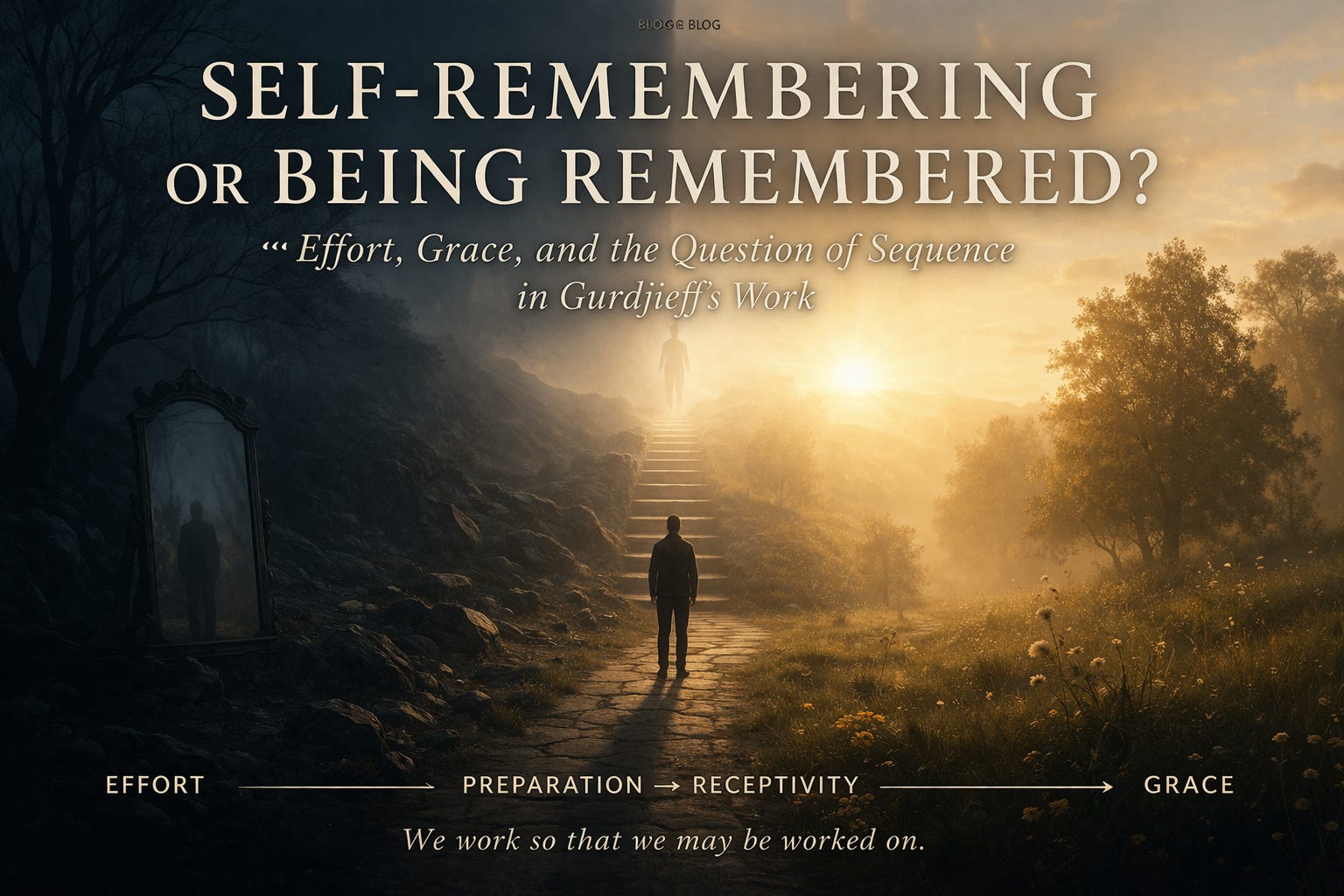
What is self-remembering? And how does this relate to the New Work idea of “being remembered,” implied in Madame de Salzmann’s “Look from Above”? Similarly, how are working on ourselves and “being worked on” related? Are these ideas opposed, or do they belong to a larger truth?
Let us begin with an account of an exchange with Gurdjieff, related by my teacher, George Adie:
To remember oneself is a mystery—it is the mystery of the work. To know it without words. It is of such prime importance that I am going to tell you of a scene at the table with Mr Gurdjieff. He sat down. We were all there together, he turned to me and said, “You understand what self-remembering means?”
I answered him. I said: “Maybe I don’t understand.”
He said: ‘‘Ah! Repeat so the others can hear.”
I repeated: “Maybe I don’t understand.”
He said: “From today you are my brother.”[1]
There is already something here that resists explanation. Self-remembering is not simply a technique or a definition; it is something that must be entered into, and even then, only partially understood. It is an emergent property of our efforts.
Self-Remembering
In ordinary life, we are aware of many things. Influences act upon us, and we react. This is a kind of awareness. But as Gurdjieff pointed out, something essential is missing: we do not include ourselves in what we perceive. Attention flows outward, from observer to observed, but the observer is asleep, unaware of the observing.
Self-remembering introduces a second dimension. I am aware not only of what I am doing, but of myself doing it. For example, in the middle of a conversation, I may suddenly notice that I am speaking—and at the same time, sense my body, my posture, the tone of my voice. Or I may catch myself identified with what I am saying, carried away by it, and in that moment, remember myself. These are small moments, but they point to something real. Attention becomes divided—outward and inward at once. Ouspensky described this as a double-headed arrow: one pointing to the world, the other returning towards oneself.
This formulation is simple, but the reality is not. As we are, our attention is weak, scattered, and easily captured. We live primarily in one centre at a time—thinking, feeling, or moving—and rarely in all three together. Yet self-remembering requires precisely this: a more unified participation of the whole of ourselves.
For this, effort is necessary. Not theoretical effort, but repeated, practical attempts to direct, divide, and sustain attention. Exercises of sensing, breath awareness, and observation are not ends in themselves; they are preparations. They strengthen what might be called the “muscle of attention” and begin to connect the parts of the machine.
These efforts constitute what Gurdjieff called the first conscious shock. They are the beginning of real Work.
The necessity of such effort is expressed with striking clarity in the Gospel of Mark 13:32-32-37 (NIV):
But about that day or hour no one knows, not even the angels in heaven, nor the Son, but only the Father. Be on guard! Be alert! You do not know when that time will come. It’s like a man going away: He leaves his house and puts his servants in charge, each with their assigned task, and tells the one at the door to keep watch. Therefore, keep watch because you do not know when the owner of the house will come back—whether in the evening, or at midnight, or when the rooster crows, or at dawn. If he comes suddenly, do not let him find you sleeping. What I say to you, I say to everyone: “Watch!”
We do not control when something higher may appear. But we are responsible for whether we are awake when it does.
The parable of the ten virgins in Matthew 25:1-13 (NIV) deepens the illustration with disarming simplicity. Ten women wait for the arrival of the bridegroom. Five bring oil for their lamps; five do not. When the bridegroom is delayed, all grow drowsy. At midnight, he arrives suddenly. Those whose lamps are lit enter with him. The others, lacking oil, rush to obtain it—but the door is shut. “I do not know you,” the bridegroom says.
The meaning is precise. The “oil” represents the results of inner work—the substance formed through conscious effort. It cannot be borrowed at the last moment. It cannot be improvised. One either has it or does not. The delay of the arrival in the story symbolises the uncertainty of Grace: it comes not in our time but in its own. The instruction is equally precise: keep watch. Remain prepared. Remember yourself.
Self-remembering, then, is effort, vigilance, and preparation. It is working on oneself. But this immediately raises a question: preparation for what?
Being Remembered
The language of the New Work offers one answer.
Following Gurdjieff’s death, Madame de Salzmann emphasised receptivity to what she called a “Look from Above.” From this came a new vocabulary: higher attention, being worked on, being remembered, voluntary passivity. These formulations point towards the action of higher influences—what, in more traditional terms, would be called Grace.
It is important to say that this is not foreign to Gurdjieff’s Work. There are stages in which something in us becomes still, silent, and receptive. In such moments, it may indeed be said that we are “worked on,” or even “remembered.”
Gurdjieff’s own cosmology, particularly as expressed in the food diagram and the law of octaves, gives a structural basis for this. The inner work of effort, struggle, and conscious labour develops the organism to a certain point. Then an interval is reached—the third of three types of intervals, designated “Harnel-Aoot” in Beelzebub’s Tales—in which further development depends less on direct effort and more on the conditions in which the process continues.
At this point, one must remain contained, without dispersion, allowing what has been prepared to settle and crystallise. In such a state—what was later described as “voluntary passivity”—one becomes receptive to higher influences. Here, the language of being “worked on” or being “remembered” becomes meaningful.
So the New Work emphasis is not without foundation. It describes something real. The difficulty arises not from the idea itself, but from how it is understood and applied.
Effort and Grace
The question of effort and Grace is not new. Religious traditions have long debated whether transformation depends on human effort or divine intervention. Framed in this way, the question becomes either-or.
Gurdjieff’s teaching does not support this division. It places effort and Grace in relationship—and, crucially, in sequence.
Without effort, nothing is formed in us that can receive anything higher. As we are, we are mechanical. We have no unified “I,” no stable centre, nothing capable of sustained relationship with higher levels. We serve only Nature.
Through effort—through self-remembering and related practices—something begins to form. The transformation of energies described in the food diagram is not symbolic; it refers to real processes in the organism and psyche. Over time, this can lead to the formation of a second body, a more stable and coherent level of Being whose centre of gravity is the first representative of Real I—the ability to pronounce, “I am,” with the totality of one’s Being.
Only through such development does real receptivity become possible. As Gurdjieff said, “Life is real only then, when ‘I am.’”
At the same time, effort alone cannot complete the process. Without help from above—without higher influences entering into the process—development cannot proceed beyond a certain point.
We prepare. Then something may be given.
Sequence
This brings us to the central point: sequence matters.
Self-remembering—the first conscious shock—is the indispensable beginning. Through sustained effort, attention becomes more stable, the centres more connected, and something more unified begins to appear in us.
Only then does the next stage become possible. At a certain point, effort gives way—not to passivity in the ordinary sense, but to a different mode: stillness, receptivity, voluntary non-interference. This corresponds to the third interval in the octave, where processes continue on the basis of what has already been prepared.
It is here that Grace can meet effort. It is here that one may meaningfully speak of being “worked on” or “remembered.”
Without the first stage, the second has no foundation.
Put simply, we work so that we may be worked on and thus become useful to the higher.
Two Errors
From this, two errors become apparent.
The first is to attempt receptivity without preparation—to seek Grace without the prior formation of anything in oneself. This leads to passivity, imagination, or what Gurdjieff called “higher sleep.” Without the prior effort, there is nothing stable to return to. One cannot, for example, sense oneself while speaking, or observe identification as it arises, because no such habit has been formed. The attempt at receptivity then floats free of any real foundation. One may feel peaceful or elevated, but nothing substantial has been formed.
The second is to rely solely on effort, without any turning towards the higher. This leads to dryness, limitation, and even stagnation. At a certain point, effort alone cannot take us further. Or worse, our efforts are hijacked by the ego self for its glorification and reinforcement.
Both errors arise from a misunderstanding of sequence.
The Turning
There comes a moment when attention begins to turn. What began as effort directed towards oneself becomes oriented towards something higher. One prepares the house, and then waits at the door. Even here, the earlier efforts remain present. The capacity to sense oneself, to remain inwardly collected while engaged in life, does not disappear; it becomes the ground from which a different kind of receptivity can appear.
At this point, receptivity is no longer passive in the ordinary sense. It is active in its own way: a conscious availability, grounded in prior effort.
In Summary
Self-remembering is the first essential effort. Being remembered is real—but only on the basis of that effort. They are not opposed. They belong to one process.
Effort, then Grace. As George Adie said:
Silence only has meaning after effort,”[2]
Preparation, then receptivity. A lawful sequence of the inner octaves.
Doing, then being worked on. Active effort is met with higher help.
Seeing, then being seen. Madame’s Look from Above. As Gurdjieff himself once said:
Perhaps, when we begin to see ourselves, the Absolute, too, begins to see us.[3]
In Closing
Self-remembering may begin as a simple act—attention turned back upon oneself in the midst of life. But if pursued seriously, it leads to something far greater.
What begins as effort can open to participation. What begins as observation can become relationship.
But the order cannot be reversed.
We cannot be remembered without first learning, however imperfectly, to remember ourselves. We cannot be worked on without first doing the work that prepares us for it.
Sequence is not a preference. It is a law.
And yet, when that law is honoured—when something in us has been prepared—there are moments when what we have sought begins, quietly at first, to seek us.
[1] Adie & Azize (2007) 204.
[2] From personal recollection.
[3] Ferapontoff & Azize (2021) 153.
Very well articulated, and useful, to be be reminded of those connections. Thank you. So you understand things differently from Joseph Azize in relation to ‘The New Work’?
Very useful, thanks. I'm still uncertain about what it feels like to be remembered by a higher influence, the next attention as its called. However I am frequently remembered by the body, through sensation. It brings me back to myself and then I make the effort to maintain it.